
 By
Voice AI is moving in-house: enterprises now are moving from renting to owning the intelligence.
With that philosophy, Quansys AI has launched a speech-to-speech model, which starts speaking in 0.32 seconds, faster than any of the 16 other voice models it was compared against, including Grok, Gemini & GPT speech models, and it runs entirely on the enterprise’s own premises with full data security.
The model is Atlas-v1, a half-duplex speech-to-speech model released in October. Instead of chaining a speech-to-text service, a language model and a text-to-speech service, it listens to audio and answers in audio directly. Around it sit the other layers a production call needs: voice detection, end-of-turn detection, orchestration, and embeddings with a vector database for memory. The team built the model, voice detection, end-of-turn detection and orchestration in-house over two and a half years, and the whole stack runs together on a single set of machines.
What the numbers show
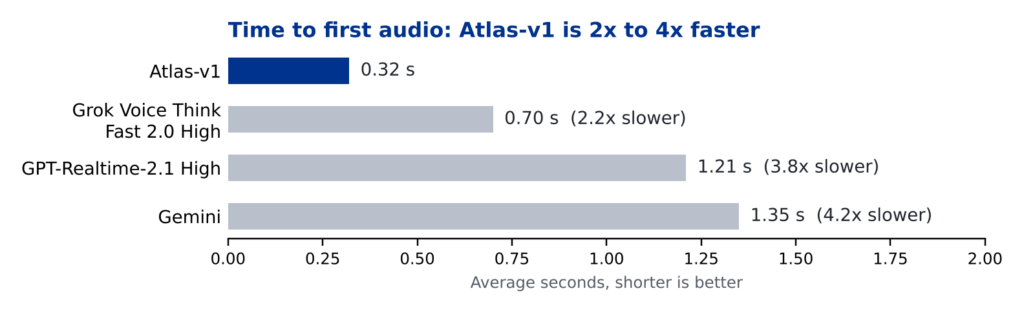
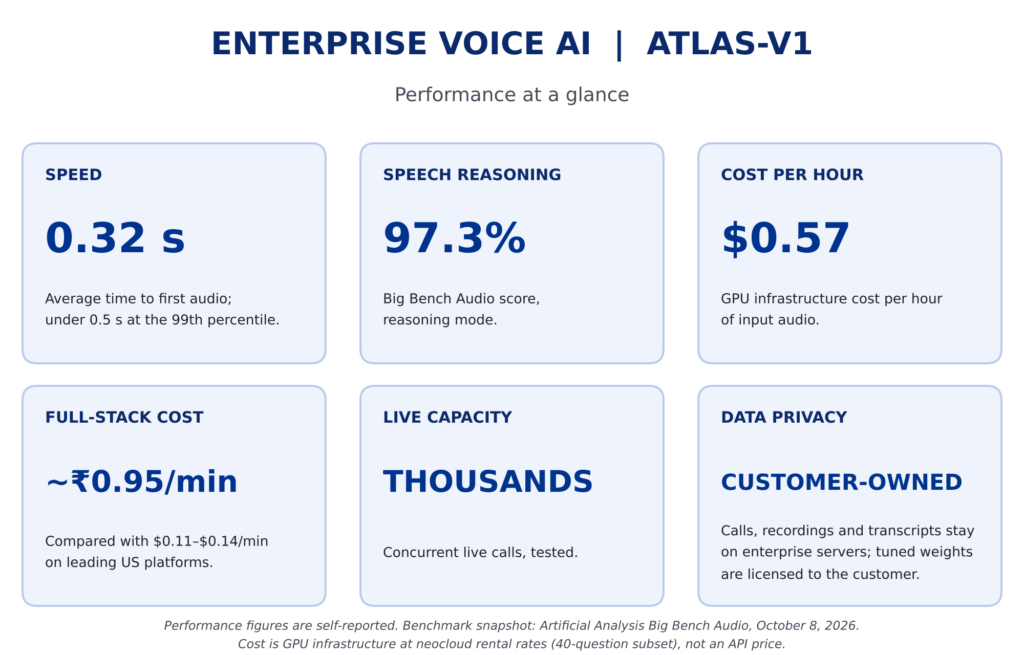
On the Artificial Analysis Big Bench Audio benchmark, Atlas-v1 started speaking in 0.32 seconds on average and in under half a second at the 99th percentile, the fastest of 17 models compared. Grok Voice Think Fast 2.0 High took 0.70 seconds, GPT-Realtime-2.1 High 1.21 seconds and Gemini 3.8 Live Extended Thinking (High) 1.35 seconds. On speech reasoning it scored 97.3%, just ahead of Grok (97.2%) and GPT-Realtime-2.1 High (95.8%). Five models score higher, but none of them starts speaking in under 1.35 seconds.
The cost gap is the part that turns heads. GPU infrastructure for Atlas-v1 works out to about $0.57 an hour of audio, against $3.50 for Gemini, $4.80 for Grok Voice Think Fast 2.0 High and $10.75 for GPT-Realtime-2.1 High at list API prices. For the full contact-center stack, that comes to around 95 paise (about INR 0.95) a minute, compared with $0.11 to $0.14 on leading US platforms.
Ownership is the other half of the story. Calls, recordings and transcripts stay on the enterprise’s own servers, and the model tuned on its calls is licensed to it, so what it learns stays theirs. That makes Atlas-v1 a natural fit for lending and collections, insurance, healthcare and government, where call volumes are high and customer data cannot leave a controlled environment. And because it runs on private cloud or fully managed private GPUs as well as on-premises, a team can start with a managed pilot and move in-house later without changing the model.
Atlas-v1 at a glance
| Measure | Atlas-v1 | Grok Voice Think Fast 2.0 High | GPT-Realtime-2.1 High | Gemini 3.8 Live Ext. Thinking (High) |
| Time to first audio | 0.32 s | 0.70 s | 1.21 s | 1.35 s |
| Speech reasoning (Big Bench Audio) | 97.3% | 97.2% | 95.8% | 97.7% |
| Cost per hour of audio | $0.57 (GPU infrastructure) | $4.80 (list API price) | $10.75 (list API price) | $3.50 (list API price) |
| Where it runs | Enterprise’s premises | Cloud API | Cloud API | Cloud API |
Green: best or near-best. Amber: mid-range. Red: furthest behind. Atlas-v1 figures are self-reported; Atlas-v1 cost is GPU infrastructure, competitor costs are list API prices.
What it means for enterprises
An enterprise buying voice AI expects a long list: low latency, high accuracy at scale, security and privacy, regulatory compliance, flexible deployment and transparent pricing. A model that owns the core layers answers several of those at once.
Why it lands now
The release arrives as enterprises rethink where AI should run. Cloudera’s June 2026 survey found 66% of enterprises moving AI workloads back on-premises or to private cloud, and voice, with its recordings and personal details, is among the most sensitive of those workloads. For lending, insurance, healthcare and government, a voice model that never sends a call to someone else’s cloud removes the hardest objection before it is raised.
It also changes who can play. Frontier-grade voice used to mean renting from a handful of global labs. Atlas-v1 suggests a small team, working end to end, can match them on speed and reasoning at a fraction of the price.
Atlas-v1 is available now through the Quansys full-stack license, starting with teams at 500,000 or more minutes a month across India, the US and the UK, with a managed pilot for those who want to start smaller.
A note on the numbers: results are self-reported, from 1,000 questions per mode on Big Bench Audio, with cost measured on a 40-question subset. Atlas-v1’s cost is GPU infrastructure at the rates for rented, fully managed private GPUs, while competitor costs are list API prices, taken from the Artificial Analysis leaderboard as of October 8, 2026. Quansys has requested an independent evaluation, and method notes are available on request.
About Quansys AI
Quansys AI Technologies Private Limited, based in Noida, India, builds full-stack, on-premise voice AI for enterprises, including its own speech-to-speech model, Atlas-v1. The model, voice activity detection, end-of-turn detection and orchestration were all built in-house over two and a half years. Learn more at quansys.ai.
Media contact
Quansys AI, hi@quansys.ai, quansys.ai